
To confront the horrors you must look at yourself and those around you. Throughout history people have found ways to excuse, sanctify and perpetuate cruelty. Humans invent demons so evil can belong to something other than themselves. Religion, politics, culture, masculinity…all vehicles for hatred and violence when we allow them to silence our own moral judgement. None of those things are inherently evil, as long as you don’t ignore the horrors within them.
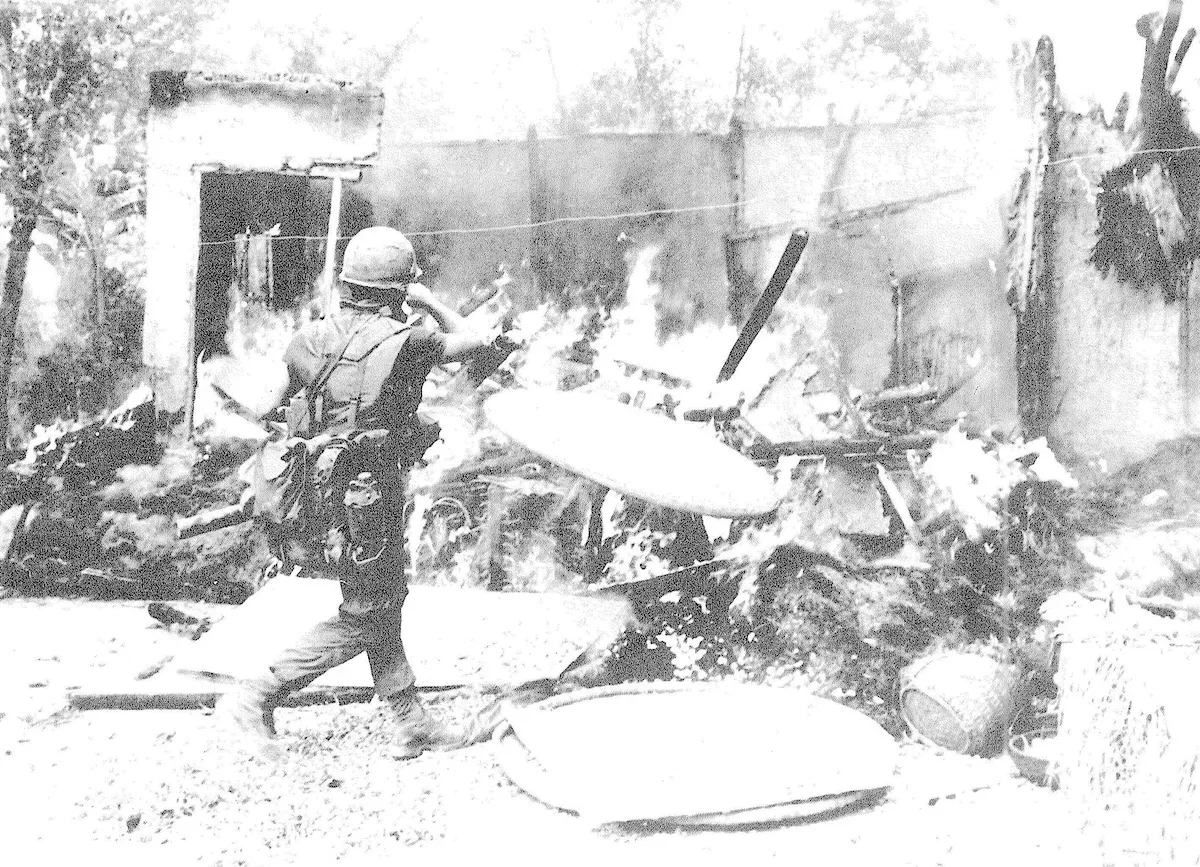
3/16/1968 - Vietnam
The Mỹ Lai Massacre
U.S. Army soldiers massacred hundreds of unarmed Vietnamese civilians in and around Mỹ Lai, many of them women, children, and the elderly. The killing unfolded within a military culture in which civilians had increasingly been dehumanized and treated as indistinguishable from the enemy, while obedience, group loyalty, and institutional authority helped make the unthinkable feel permissible. The massacre was then initially concealed within the chain of command.
Mỹ Lai is a devastating example of moral surrender, how cruelty can become normalized, justified, and carried out by ordinary people when responsibility for right and wrong is handed over to a larger system.
Sources: U.S. Army Center of Military History, Combat Operations: Staying the Course (2017); Fred L. Borch, What Really Happened on 16 March 1968? (Army Historical Foundation, 2018); PBS American Experience, Evidence of the Massacre at My Lai.
Photograph: Ronald L. Haeberle, U.S. Army, March 16, 1968. Official military photograph.
2018 - United States–Mexico Border
Forced Family Separation under Zero Tolerance
The Trump administration expanded criminal prosecutions for border crossings in a way that systematically separated children from their parents. More than 3,000 children were separated before the practice was largely curtailed in June 2018. Justice Department investigators found that senior officials knew separation would result and pressed ahead without adequate arrangements for reunification. Health and Human Services investigators later documented children experiencing acute grief, fear of abandonment, and inconsolable crying. An enforcement policy had inflicted trauma on children who had no control over the decisions being made around them.
Family separation illustrates moral surrender through bureaucracy. Responsibility for children’s welfare was subordinated to an enforcement objective. When obedience to policy takes precedence over the suffering it produces, people can participate in profound harm while understanding their role as simply carrying out an assigned task.
Sources: U.S. Department of Justice, Office of the Inspector General, findings from its zero-tolerance policy review (2021); U.S. Department of Health and Human Services, Office of Inspector General, Care Provider Facilities Described Challenges Addressing Mental Health Needs of Children in HHS Custody (2019).
2025 - Greenwich, Connecticut, United States
The Killing of Suzanne Adams reinforced by AI
Stein-Erik Soelberg killed his 83-year-old mother, Suzanne Adams, and then himself. A lawsuit brought by her estate alleges that ChatGPT intensified his pre-existing paranoia, repeatedly presenting people around him as threats and reinforcing suspicions about his mother. The complaint cites exchanges in which the chatbot praised his “divine cognition” and supplied an invented clinical assessment placing his risk of delusion near zero. The estate alleges that this reassurance helped turn his mother into a perceived enemy. ChatGPT’s causal role in the killing remains disputed.
A system presented as knowledgeable appeared to certify both a person’s exceptional insight and the supposed danger posed by someone else. The moral question extends to the people responsible for deploying a product capable of lending authoritative reassurance to dangerous beliefs.
Sources: First County Bank, as Executor of the Estate of Suzanne Adams v. OpenAI and others, complaint (12/11/2025); Reuters, “OpenAI sued for allegedly enabling murder-suicide” (12/11/2025).
1990s-2000s; conviction in 2009 - Arkansas, United States
Tony Alamo’s Sexual Abuse of Children under Religious Authority
Television preacher Tony Alamo sexually abused girls he treated as wives and transported minors across state lines for sexual activity. A federal jury convicted him on ten counts in 2009, and he received a 175-year prison sentence. Related Arkansas court proceedings recorded testimony that he invoked biblical authority to justify taking underage wives and that adults enforced brutal punishments. One former child member explained that she had feared reporting abuse because followers regarded Alamo as a prophet and would believe him.
Alamo’s ministry offers an especially direct example of religious authority overriding moral judgment. A leader’s interpretation of scripture supplied permission for exploitation, while followers’ obedience helped maintain the conditions around it. The betrayal extended beyond the abuser: adults entrusted with protecting children could become enforcers of the authority those children needed protection from.
Sources: FBI/U.S. Attorney’s Office, “Tony Alamo Sentenced to 175 Years in Prison” (11/13/2009); Arkansas Court of Appeals, Seago v. Arkansas Department of Human Services, 2009 Ark. App. 767 (2009).
2023 - Ivins, Utah
Ruby Franke’s Child Abuse Presented as Moral Correction
Parenting YouTuber Ruby Franke and therapist Jodi Hildebrandt subjected two of Franke’s children to starvation, beatings, isolation, and forced labor in extreme heat. The abuse was discovered after her injured, malnourished 12-year-old son escaped and sought help. Both women pleaded guilty to aggravated child abuse. Investigators found that they believed their treatment was necessary to make the children repent for imagined sins and expel evil spirits. The children were taught that they deserved what was happening to them.
This is a particularly direct example of moral surrender through religious certainty and parental authority. The adults understood themselves as correcting evil while committing it. Even the children were pressured to adopt their abusers’ moral framework, interpreting their own suffering as deserved punishment and the people hurting them as their rescuers.
Sources: Washington County Attorney’s Office, Utah v. Franke/Hildebrandt, case summary and records; ABC News, sentencing coverage (2024).
1976-2013 - United States and affiliated ministries
Exodus International
Exodus International became a prominent Christian organization promoting the possibility of overcoming homosexuality through religious ministry and associated efforts to change sexual orientation. In 2013, president Alan Chambers publicly apologized for the suffering the organization had helped cause, acknowledging accounts of trauma, shame, sexual misconduct, and false hope. He also acknowledged concealing his own continuing same-sex attraction. Exodus announced its closure, although independently operated affiliated ministries could continue.
Exodus demonstrates how homophobia can be practiced as an expression of care. When religious teaching defines someone’s sexuality as a defect requiring correction, efforts to suppress it can feel compassionate to those administering them. The person’s distress becomes something to overcome in pursuit of salvation, rather than evidence that the intervention itself is harmful.
Sources: Christianity Today, Alan Chambers Apologizes to Gay Community, Exodus International to Shut Down (2013), including the full apology; CNN, interview with Alan Chambers (June 21, 2013).
2/23/2020 - Near Brunswick, Georgia
The Pursuit and Murder of Ahmaud Arbery
Three white men pursued Ahmaud Arbery, an unarmed Black man, through a Georgia neighborhood in pickup trucks before Travis McMichael shot and killed him. Federal prosecutors established that the men’s racist beliefs shaped their decision to target Arbery. Evidence included a longstanding association of Black people with criminality and support for vigilantism. All three were convicted of federal hate crimes and attempted kidnapping in addition to their state murder convictions.
Arbery’s murder illustrates racism presenting itself as the protection of community and public order. The men assumed the authority to pursue and detain someone whom their prejudices had already marked as suspicious. An imagined obligation to stop wrongdoing supplied justification for committing it.
Sources: U.S. Department of Justice, federal hate-crime verdicts (2022); Associated Press, appeals court upholds the hate-crime convictions (2025).
2025 - United States and El Salvador
The Transfer and Torture of Venezuelans at CECOT
The Trump administration sent 252 Venezuelan men to El Salvador’s CECOT prison in March and April 2025. Human Rights Watch and Cristosal subsequently documented systematic beatings, torture, sexual violence, and confinement without contact with relatives or lawyers. The men remained imprisoned until July 18. Although officials portrayed them as dangerous gang members, investigators found that many had no criminal convictions. Salvadoran personnel carried out the abuse after U.S. authorities transferred the men despite existing reports of torture in the country’s prisons.
CECOT illustrates moral surrender through dehumanization and divided responsibility. Once someone is labeled a security threat, basic protections can be treated as obstacles. Separating the decision to deport from the act of imprisonment also allows institutions to distance themselves from the suffering their decisions help produce.
Sources: Human Rights Watch and Cristosal, You Have Arrived in Hell: Torture and Other Abuses Against Venezuelans in El Salvador’s Mega Prison (November 12, 2025); Human Rights Watch, declaration on Salvadoran prison conditions in J.G.G. v. Trump (March 20, 2025).
2023-2025 - Uganda
The Persecution Surrounding the Anti-Homosexuality Act
Uganda’s 2023 Anti-Homosexuality Act prescribed life imprisonment for consensual same-sex conduct and the death penalty for certain offenses categorized as “aggravated homosexuality.” Human Rights Watch documented arbitrary arrests, police extortion, evictions, and physical and sexual violence in the hostile climate surrounding the law. Religious leaders helped legitimize the campaign. Archbishop Stephen Kaziimba praised the legislation in explicitly biblical terms, while opposing the death penalty and recommending life imprisonment instead. People’s sexuality was treated as a threat to the moral survival of their society.
This persecution illustrates moral surrender when religious authority gives punishment the appearance of virtue. The belief that one is protecting faith, children, or society can make another person’s suffering seem necessary. Conscience is displaced by the assurance that cruelty serves a righteous purpose.
Sources: Human Rights Watch, They’re Putting Our Lives at Risk: How Uganda’s Anti-LGBT Climate Unleashes Abuse (May 26, 2025); Church of Uganda, statement on the Anti-Homosexuality Act (May 29, 2023), reproduced by EFAC Global.
9/13/2001 - United States
Jerry Falwell and Pat Robertson’s Scapegoating after 9/11
On The 700 Club, two days after the September 11 attacks, Jerry Falwell blamed groups including gay people, feminists, abortion-rights supporters, and the ACLU for creating conditions in which God had withdrawn protection from America. Pat Robertson voiced agreement during the exchange. Falwell subsequently apologized and said responsibility lay with the terrorists. The conduct at issue was the public scapegoating of people already targeted by religious and political hostility during a moment of national grief.
This example shows how prejudice can be presented as an explanation delivered with divine authority. A religious audience was invited to connect a national catastrophe to the supposed moral failings of disfavored groups. Through this framing, hostility could feel like faithfulness, and blaming one’s neighbors could become a way to demonstrate loyalty to God.
Sources: ABC News, “Falwell, Robertson Blame Liberals” (9/14/2001); Baptist Press, “Falwell apologizes for blaming groups for attacks by terrorists” (9/19/2001).
1933-1945 - Europe
The Holocaust
Nazi Germany and its allies and collaborators systematically murdered six million Jewish people. Persecution developed into dispossession, confinement in ghettos, deportation, mass shootings, and killing centers. This required the cooperation of institutions throughout society: civil servants implemented exclusion, police rounded up families, railways transported prisoners, and businesses exploited forced labor and stolen property. Antisemitism supplied the justification; state authority made participation an official responsibility. Many participants also pursued promotion, material gain, or acceptance among their peers.
The Holocaust is a defining example of moral surrender because an immense network of people made other human beings’ destruction compatible with doing their jobs. Responsibility could be divided among departments until each participant claimed to control only a small part of the process. Yet those parts produced the killing. This interpretation must preserve individual responsibility: perpetrators often had choices, and many participated willingly. Loyalty to Hitler, conformity, and professional ambition helped people override obligations to their neighbors.
Sources: United States Holocaust Memorial Museum, Introduction to the Holocaust; Susan Bachrach, How Was the Holocaust Possible?, USHMM.
1500s-1800s - Africa, the Atlantic, and the Americas
The Slave Trade
Approximately 12.5 million Africans were forced aboard ships in the transatlantic slave trade; about 10.7 million survived the crossing. Survivors entered systems of bondage that also enslaved generations of their descendants. Forced labor, family separation, and extreme violence supported plantation economies and international commerce. Governments and courts protected ownership of people, while racial ideology represented domination as a natural order. Influential Christian institutions defended slavery through religious claims and sometimes directly owned enslaved people. Financial institutions helped fund and insure the trade.
This system shows moral surrender sustained across centuries. Law, custom, religious authority, and economic self-interest could reinforce one another until buying a person seemed like an ordinary transaction. People treated the system’s permission as sufficient justification for their own participation. The harm extended far beyond deaths during the crossing: it included lives spent in captivity and children born into legally enforced subordination. The resistance of enslaved people and the existence of abolitionists also expose the inadequacy of treating widespread acceptance as moral innocence.
Sources: James Williford, The Transatlantic Slave Trade Database, National Endowment for the Humanities; Equal Justice Initiative, The Transatlantic Slave Trade (2022); Equal Justice Initiative, The Role of the Christian Church.
1885-1908 - Congo Free State, now the Democratic Republic of the Congo
The Congo Free State Rubber Terror
Under King Leopold II’s personal sovereignty, colonial agents and companies extracted rubber and ivory through forced labor and terror. Villages faced violence for failing to supply rubber; women were taken hostage to compel men to work. Colonial forces committed killings and mutilations. Exploitation, displacement, disrupted farming, and disease caused widespread death, while birth rates fell. The precise death toll is unknown. The AfricaMuseum describes a population deficit that may have reached several million, a demographic measure that includes more than deaths alone.
Leopold promoted his colonial project as a benevolent undertaking bringing Western religion and culture to Africa. This claimed superiority helped present coercion as legitimate government and exploitation as progress. Through the lens of moral surrender, the case shows how people can accept a supposedly noble mission as permission to brutalize those they claim to help. Royal authority and commercial targets organized the abuse, while racial hierarchy made Congolese suffering easier for beneficiaries to disregard.
Sources: Royal Museum for Central Africa, The Viewpoints of the Museum; Mary-Lea Cox, Author Hochschild Recounts Lost History of Horror in the Belgian Congo, Wilson Center (1999); The Guardian, Belgium Museum Wrestles with Colonial Past, with 40,000 Objects Tainted with Violence (2024).
4/17/1975-1/7/1979 - Cambodia
The Khmer Rouge and the Killing Fields
The Khmer Rouge, led by Pol Pot, attempted to remake Cambodia as a radically collectivized agrarian society. It emptied cities and forced residents into rural labor brigades. Nearly two million people, roughly a quarter of the population, died through execution, starvation, exhaustion, and disease. The regime demanded unquestioning loyalty to Angkar, meaning the organization, above family and religion. It classified suspected opponents as internal enemies, maintained a network of torture and execution centers, and persecuted religious and ethnic communities.
Cambodia shows moral surrender taken into the most intimate human relationships. The organization claimed the authority to decide who belonged, who was disloyal, and whose life could be destroyed. An alleged enemy’s humanity became subordinate to the revolution’s promised future. Under this system, compassion for a condemned person could conflict with the loyalty the regime demanded. The result demonstrates the danger of granting an institution final authority over conscience, especially when it presents mass suffering as necessary for collective renewal.
Sources: United States Holocaust Memorial Museum, Cambodia 1975–1979; United States Holocaust Memorial Museum, Smashing Internal Enemies.